Sunday, October 11, 2015

Fantastic Pair of 4 Drawer Chests by Raymond Loewy

Although he may not be the first designer that comes to mind for furniture enthusiasts, Raymond Loewy is arguably one of the most significant and influential designers of the modern movement.  His industrial and graphic designs helped form the landscape of post-war America.  His long list of designs are familiar to all of us and include: logos for Shell, BP, Exxon, TWA, Lucky Strike cigarettes, the livery for Air Force One, the Studabaker Avanti and countless others.  He also designed a number of furniture lines.

These chests were designed by Loewy for Mengel Furniture in 1947.  This is a period where Art Deco was still a big influence in modern design and the Bauhaus trained designers had only just started importing their style into American furniture.  The cases and drawer fronts are made of solid oak with the drawers having a subtle bevel on the top and bottom edges.  The solid brushed aluminum pulls mimic the drawer profiles.  These 2 chests had different finishes on them when I acquired them.  One was a traditional medium brown tone.  The other had a gray/green finish that looked very dated and worn.  With their tie to deco design and oak construction with fairly simple lines, I decided they would be candidates for a cerused finish.  I opted to use a dark, chocolate brown base and filled the grain with white.  The result is a stunning transformation that not only makes a huge visual impact but is correct to the period as this technique was often used in deco furniture design.

This pair of chests would make a great dresser or credenza when placed side by side.  They could also be used as a large set of nightstands or end tables.  The finish creates a versatile style that would look great with modern, deco, industrial, gothic, farmhouse or traditional decors.

Dimensions for each: 34"W x 32"H x 19.5"D
Sold


Friday, October 9, 2015

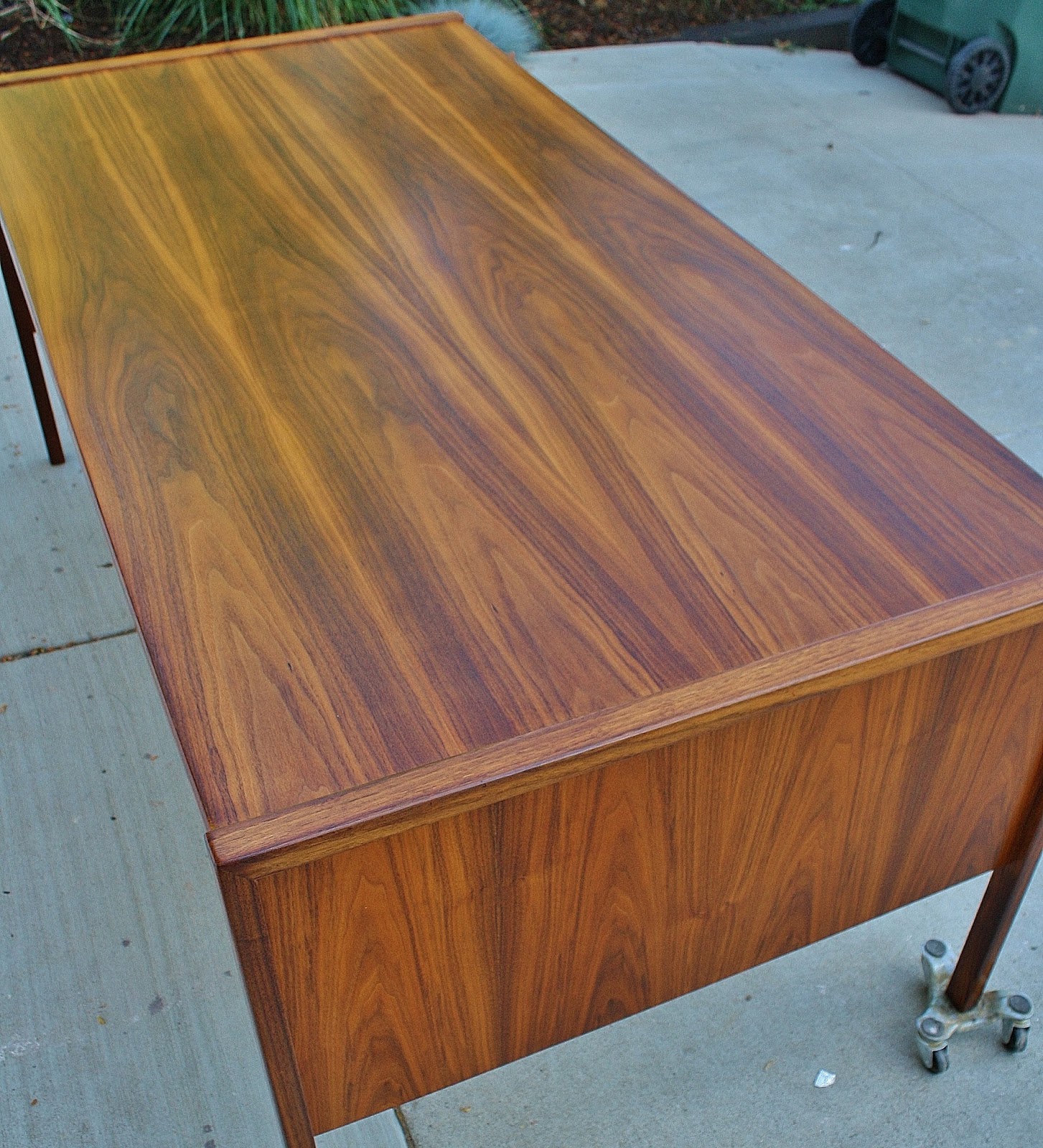
Restored Walnut Executive Desk by Jens Risom

Jens Risom is often credited as being one of the first to bring contemporary Scandinavian design to America.  The wood and webbing chair he designed for Knoll in 1941 is his most well known design and considered a classic.  His importance and influence in contemporary home and office furniture design guarantees they will all become classics.  Risom is one of the few founders of the modern movement that is still alive.  He will be 100 years old next year and continues to design furniture.

This walnut executive desk from the 1960's has just been completely restored.  Stunning from every angle, it defines the modern design ethos of combining simple, well proportioned design with beautiful materials to create timeless pieces that defy trends or styles.  All the materials in this desk are of the highest quality.  The legs, drawer pulls and case edges are created from solid walnut.  The walnut veneers used in the case panels are well figured with great color variation.  The drawer boxes are made of mahogany and are all supported on 100 lb capacity roller bearing drawer slides.  The file drawer can hold either legal or letter sized files and they are supported on sturdy aluminum rails.  Fine craftsmanship is evident throughout the piece, it was built to be as functional and durable as it is beautiful.

The desk in configured with 2 floating pedestals, the left pedestal having a small upper drawer and a lower file drawer.  The right pedestal has a small upper and 2 medium drawers.  There is a thin drawer above the knee well.  Inside the kneewell is a foot rest shelf.

This desk also comes with a 1/4" thick piece of heavy glass to keep the top protected.  I did not photograph with the glass in place as the reflections obscure the view of the wood top and it is too heavy for me to put in place alone.

Dimensions:  68"W x 34"D x 28 1/2"H

Sold


Tuesday, September 29, 2015

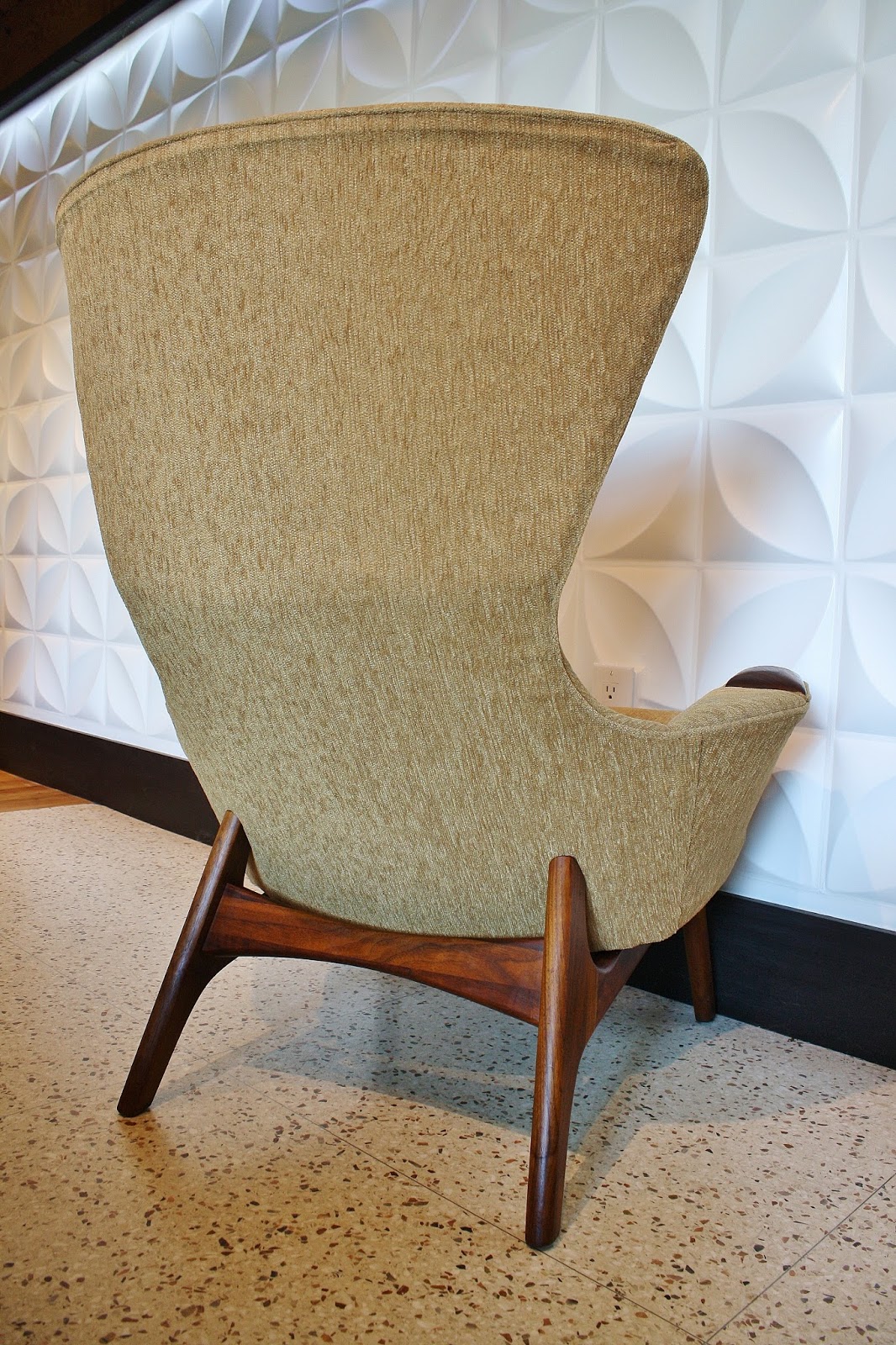
Rare Adrian Pearsall Wingback Lounge Chair

Adrian Pearsall's style is the epitome of mid-century American design.  The dramatic and exuberant lines echoed other design industries of the era that looked forward from the jet age into the rocket and atomic age.   Swooping lines and fins made their way into cars, architecture and other fixtures of modern American life.  Pearsall brought this into America's living room.

The 2231-C wingback chair exhibits a number of these design features.  The heavily canted back and gracefully curved legs resemble the angular jet-set lines of the automobiles of the time.  While many traditional wingback chairs look overstuffed and heavy, the lines of the back of this chair are of a slim profile that dreamers of the period might have imagined in their flying car or rocket ship.  While achieving this futuristic look, Pearsall also designed a very comfortable chair.  Although it doesn't recline, its angles and stature do not make it necessary.  My wife exclaimed as she sat in this for the first time "Ooh, I want to keep this one!"

This chair has been recently reupholstered in a tan chenille fabric that is softly textured.  The legs and arm pads are all of solid walnut and is in excellent shape.  The frame joints are all rigid and sturdy.

This is a link to a copy of the page from the Craft Associates catalog

 https://web.archive.org/web/20140318183828/http://adrianpearsall.com/2231C.pdf

This is a great piece of functional art for a mid-century collector.
Sold
(Note: The dark areas that appear on the back, particularly just below the top edge is a shadow from the frame of the chair.  The fabric is not stained or worn in any way)


Walnut and Leather Mid Century Credenza

Although I do not have confirmation, I'm reasonably confident in attributing this piece to Founders Furniture, likely designed by Jack Cartwright.  For one, it was accompanied by a number of other pieces by Founders and Thomasville (Founders parent company).  It has many details that identify it as a Cartwright designed piece.  Cartwright has used leather in a number of his case piece designs.  He also often used square shaped legs, set out on the corners of the case.  The oiled finish and prodigious use of solid walnut in doors, edges, legs, etc although not unique to Founders and Cartwright give further credence to the attribution.  The construction and configuration of the doors, case and interior fittings also match some other Founders pieces of similar design.

The oiled finish used on this piece has given the walnut and very warm color, much more than the typical lacquered finish of the era.  The walnut exhibits great color variation and figuring.  Inside, the cabinet is divided into 3 different sections that are concealed by 2 doors per section.  The other 2 sections have one adjustable shelf each.  The center section adds one felt lined drawer that is divided into 3 sections.  The legs and pedestal are all constructed of solid walnut, not the typical dyed white wood or veneer over white wood.

With its ample open storage, this piece could be used in a number of applications from media stand, to dining room buffet or office credenza. The black leather finished doors would tie in well with other leather seating surfaces in the room.

Dimensions: 71 1/2"W x 30"H x 18"D

Sold